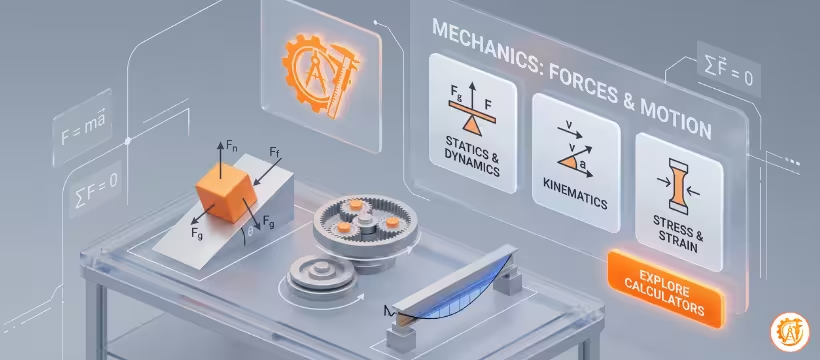
Newton's Laws of Motion
The foundation of classical mechanics — force, mass, and acceleration.
Newton's Laws of Motion – The Rules That Govern All Forces
Understand the three fundamental laws that describe how forces affect the motion of objects. From inertia to action-reaction, these principles underpin all of classical mechanics.
What are Newton's Laws?
Newton's three laws of motion, published in 1687, form the cornerstone of classical mechanics. They describe the relationship between a body and the forces acting upon it, and how those forces govern its motion. These laws are universally applicable to everyday engineering problems — from designing machines to analyzing structural loads.
Why are Newton's Laws Important?
Every analysis in structural engineering, mechanical design, robotics, and vehicle dynamics relies on Newton's Laws. They allow engineers to predict how objects will respond to forces, design safe structures, and model complex multi-body systems. Without them, modern engineering analysis would be impossible.
The Three Laws at a Glance:
- 📌 First Law (Inertia) – An object remains at rest, or in uniform motion, unless acted upon by a net external force.
- 📌 Second Law (F = ma) – The net force on an object equals its mass multiplied by its acceleration.
- 📌 Third Law (Action-Reaction) – For every action force, there is an equal and opposite reaction force.
- 📌 Weight – The gravitational force W = mg acts downward on every mass near Earth's surface.
- 📌 Normal Force – The perpendicular contact force a surface exerts on an object, N = mg·cosθ on inclines.
- 📌 Free Body Diagrams – Visual tools for identifying and summing all forces on a body.
- 📌 Equilibrium – When net force is zero; the object is in static or dynamic equilibrium.
What You'll Find in This Section
This section provides interactive calculators for Newton's Second Law with three-way solving (force, mass, or acceleration), weight and normal force analysis for both flat and inclined surfaces, and action-reaction pair analysis for two interacting bodies. Each tool includes step-by-step solutions with KaTeX-formatted formulas and unit conversions for professional engineering work.
Newton's Laws Calculators
Apply Newton's three fundamental laws to solve real-world mechanics problems. From calculating the force needed to accelerate a body, to finding weight on inclined surfaces, to analyzing action-reaction pairs in interacting systems.
Second Law (F = ma): Relate net force, mass, and acceleration. Solve for any unknown given the other two.
Weight & Normal Force: Calculate gravitational weight and the perpendicular contact force on inclined planes.
Third Law — Action & Reaction: Analyze the equal-and-opposite force pairs that objects exert on each other.
Newton's Second Law Calculator
Newton's Second Law states that the net force acting on an object equals its mass multiplied by its acceleration. Use this calculator to solve for any one of the three quantities.
Select what to solve for:
Weight Calculator
Weight is the gravitational force acting on an object. Near Earth's surface, it equals mass × g (9.81 m/s²). Weight is a vector force pointing toward the Earth's center.
Normal Force on an Inclined Plane
When an object rests on an inclined surface, the normal force is perpendicular to the surface and equals the component of weight acting in that direction.
Newton's Third Law — Action & Reaction Pairs
Newton's Third Law states that for every action force, there is an equal and opposite reaction force. Enter two interacting objects to calculate the forces they exert on each other.