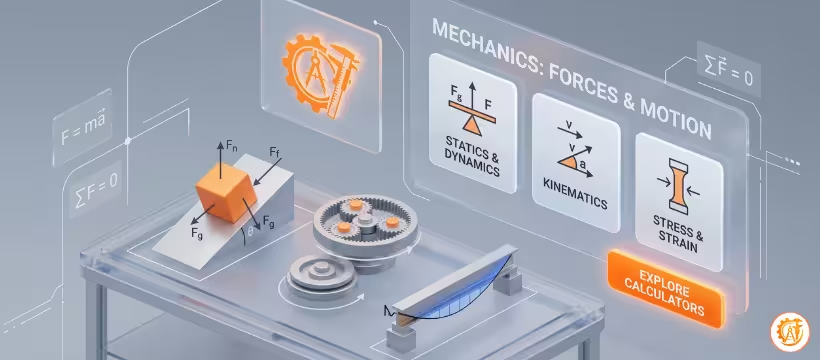
Mechanics – The Foundation of Motion and Force
Mechanics – The Foundation of Motion and Force
Understand the core principles that govern the physical world — from the movement of particles to the forces shaping machinery.
What is Mechanics?
Mechanics is a foundational discipline within physics and engineering that deals with the study of objects in motion and the forces that act upon them. Whether an object is stationary or in motion, mechanics explains how and why it behaves the way it does. The subject is typically divided into two major branches: statics (the study of forces in systems at rest) and dynamics (the study of forces in motion). Together, these principles govern nearly every physical system, from simple machines and industrial robots to vehicles, bridges, and even the human body.
Why is Mechanics Important?
Mechanics plays a pivotal role in modern engineering. It provides the analytical tools necessary to model, simulate, and predict the behavior of structures and mechanical systems. For instance, understanding the forces in a truss structure ensures that a bridge doesn't collapse under load. Similarly, analyzing the motion of gears in a transmission system guarantees optimal power transfer. Without mechanics, designing safe, efficient, and cost-effective products and infrastructure would be impossible. Its applications span industries including aerospace, automotive, robotics, biomechanics, civil construction, and more.
Core Areas Covered in This Section:
- 📌 Kinematics – The study of motion without considering its causes, focusing on displacement, velocity, and acceleration.
- 📌 Dynamics – Involves analyzing the forces and torques that produce motion. It includes both linear and rotational dynamics.
- 📌 Newton’s Laws – The three fundamental laws that form the basis for classical mechanics, explaining the relationship between force and motion.
- 📌 Work & Energy – Explores how energy is transferred or converted by forces acting through distances, introducing concepts like kinetic and potential energy.
- 📌 Impulse & Momentum – Deals with the effect of force applied over time and its ability to change the motion (momentum) of an object.
What You’ll Find Here
This section is designed as both a learning resource and a practical toolbox for mechanical and civil engineers, physics students, and technical professionals. Each calculator includes: - A brief introduction to the topic. - Definitions of key physical quantities (e.g., Force, Displacement, Mass, Acceleration). - Units of measurement and commonly used symbols. - Governing formulas with contextual explanations. - Interactive inputs with instant, step-by-step numerical solutions. These tools not only help you solve textbook-style problems but also serve as reference guides during real-world design and analysis tasks.
Explore Mechanics
Dive into the core principles of classical mechanics. Choose a topic below to get started with intuitive definitions, formulas, and calculator tools built for mechanical engineers.